Web3 infrastructure is the technical foundation that lets decentralized websites store, route, verify, and deliver content without depending on one central origin server. Web3 hosting is only one part of that foundation. A production-ready setup also needs storage persistence, gateways, nodes, CDN, APIs, databases, monitoring, access control, and cloud security.
This is the main difference between a demo and a live product. A demo can publish static files to IPFS and share a gateway link. A business-grade decentralized website needs predictable access, version control, rollback, uptime monitoring, and secure integration with cloud services.
For teams comparing web3 hosting, decentralized web hosting, and traditional cloud, the practical question is not “which model is more decentralized?” The better question is: which parts of the stack should be decentralized, and which parts still require managed infrastructure?
GAIA Information Technology supports this type of architecture through cloud infrastructure planning, Kubernetes, CDN, cloud security, databases, AI, big data, and API development services. That matters because decentralized layers still need production-grade infrastructure around them.
What is Web3 infrastructure for decentralized websites?
Web3 infrastructure for decentralized websites is a layered architecture that combines distributed storage, content addressing, gateways, naming systems, cloud services, and operational monitoring. It allows public content to be verifiable and distributed, while dynamic workloads remain secure and manageable.
IPFS is one of the core technologies used in this model. Its official documentation describes IPFS as open protocols for addressing, routing, and transferring data on the web, built on content addressing and peer-to-peer networking.
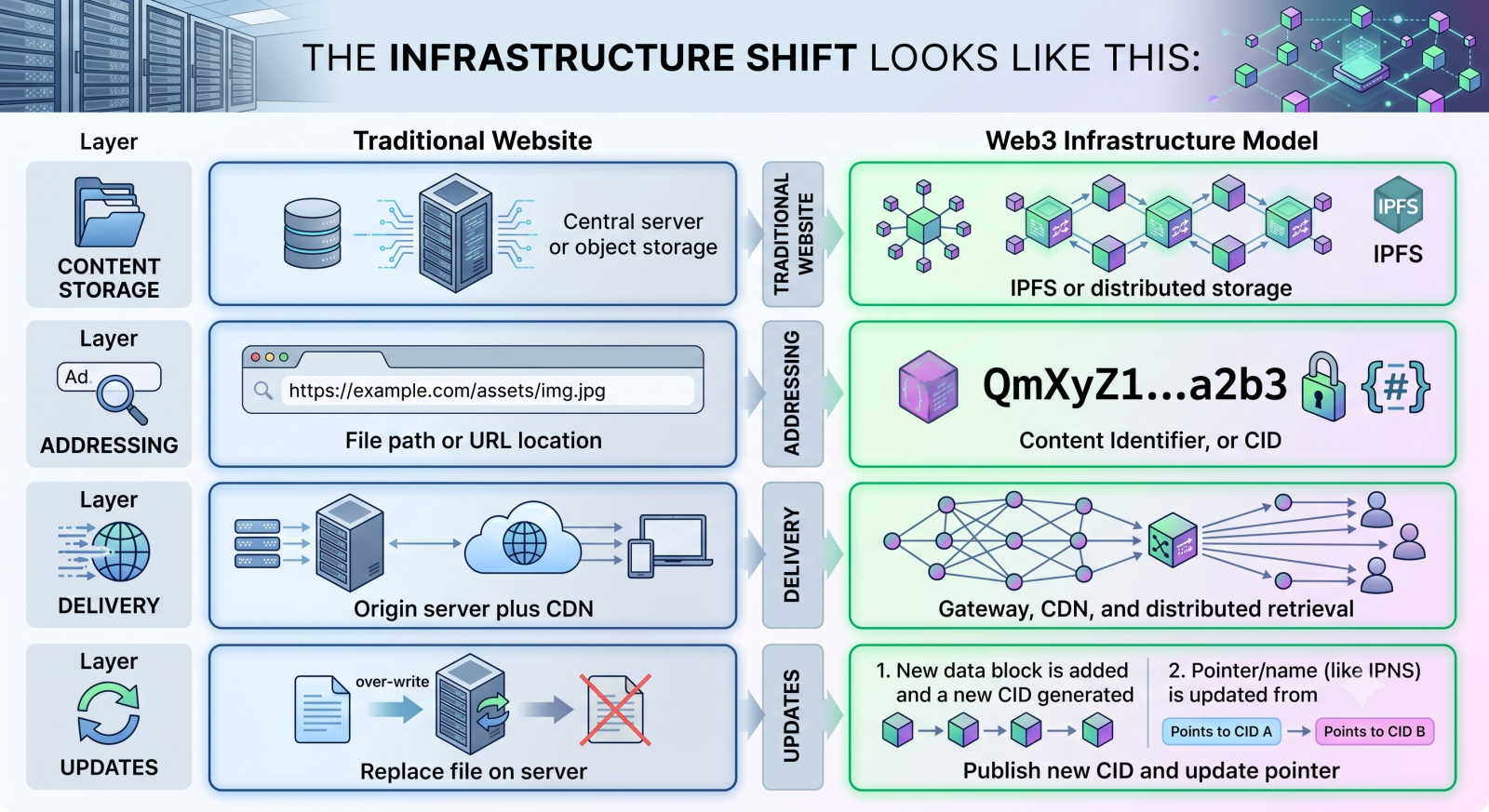
This is why decentralized websites should not be treated as simple static hosting projects. They are infrastructure projects with different failure points.
Why infrastructure matters more than hosting
Infrastructure matters more than hosting because decentralized delivery does not automatically guarantee availability, performance, or security. A file can have a CID and still be slow, unavailable, poorly monitored, or disconnected from the rest of the application.
IPFS uses content addressing, which means content is identified by what it is, not where it sits. The IPFS documentation explains that content identifiers are used to handle content-addressed data.
That creates three operational consequences:
-
Every content change creates a new CID.
-
The latest version needs a stable pointer.
-
Long-term availability depends on persistence planning.
Pinning is central here. IPFS documentation explains that data must be pinned to one or more nodes to persist and avoid deletion during garbage collection.
So the real work is not only “upload files.” It is designing an infrastructure layer that keeps content available, fast, observable, and recoverable.
Core components of decentralized website infrastructure
A reliable decentralized website usually runs on a hybrid architecture. Distributed systems handle public, verifiable content. Cloud infrastructure handles dynamic logic, APIs, analytics, monitoring, and private data.
| Component | Infrastructure Role | Why it matters |
| Distributed storage | Stores static files and public assets | Reduces reliance on one origin |
| Pinning layer | Keeps content available | Prevents accidental disappearance |
| Gateway | Makes content accessible in browsers | Needs uptime and latency monitoring |
| Naming system | Maps readable names to CIDs | Enables updates without confusing users |
| CDN | Improves global delivery | Reduces gateway latency |
| Cloud APIs | Handles dynamic services | Supports authentication and business logic |
| Database layer | Stores private or changing data | Keeps sensitive data off public storage |
| Monitoring | Tracks uptime, latency, and failures | Makes the system operable |
This is where decentralized website hosting becomes only one part of a broader infrastructure plan. The website may be decentralized at the content layer, but the surrounding systems still need enterprise-grade cloud engineering.
Web3 server and node strategy
A web3 server is usually part of the infrastructure that supports IPFS nodes, gateways, blockchain nodes, APIs, or backend services. In small projects, one node or a managed gateway may be enough. In production, web3 servers need redundancy, storage planning, access control, and monitoring.
The infrastructure model changes as the project grows:
.png)
Oracle’s cloud infrastructure guidance for Web3 workloads highlights compute, high-throughput networking, fast storage, scalability, and global availability as important infrastructure requirements.
The main takeaway is simple: web3 servers should be managed like critical infrastructure, not like experimental side tools.
Where cloud infrastructure fits
Cloud infrastructure fits around the decentralized layer. It supports APIs, databases, analytics, search, authentication, CI/CD, monitoring, and secure access controls. These functions usually should not be pushed into distributed storage.
For example, static documentation, public metadata, and open-source assets may work well on distributed storage. User dashboards, payment flows, admin panels, search, and analytics usually need cloud services.
This is especially important for products with real-time interfaces, including an online gaming platform. Public assets can be distributed, but user-specific systems still need low-latency compute, private databases, and strict access rules.
A practical split looks like this:
| Workload | Better infrastructure choice | Reason |
| Static public website | decentralized website hosting | Content can be verified by CID |
| Public documentation | decentralized hosting | Good fit for transparent access |
| Dynamic user area | Cloud infrastructure | Requires privacy and frequent updates |
| API backend | Cloud services | Needs access control and monitoring |
| Global asset delivery | CDN plus gateway | Improves speed and resilience |
| Sensitive data | Managed database | Should not be stored publicly |
This hybrid model gives teams resilience without sacrificing performance or control.
Blockchain web hosting vs blockchain infrastructure
Blockchain web hosting usually refers to publishing website assets through decentralized or blockchain-adjacent systems. Blockchain infrastructure is broader. It may include RPC nodes, smart contract interaction, indexing services, wallets, APIs, monitoring, and secure backend systems.
The same distinction applies to blockchain website hosting. Publishing the front end is only one task. The larger infrastructure must support the full application lifecycle.
For a decentralized application interface, the stack may include:
-
Static front end on IPFS or similar storage.
-
Naming layer through DNSLink or another pointer system.
-
Gateway and CDN for browser access.
-
Backend APIs for dynamic functions.
-
Database and analytics layer.
-
Security monitoring and access control.
-
CI/CD pipeline for controlled releases.
This is the level where infrastructure planning becomes more important than the hosting label.
How to build decentralized infrastructure step by step
To build decentralized infrastructure for a website, start by separating static public content from dynamic systems. Then design storage, naming, delivery, security, and monitoring as one architecture.
A practical workflow:
-
Define which content should be decentralized.
-
Build static assets for distributed storage.
-
Publish content and generate CIDs.
-
Pin content through reliable nodes or services.
-
Connect naming through DNSLink or another pointer.
-
Add gateway fallback and CDN.
-
Keep APIs and databases in secure cloud infrastructure.
-
Add monitoring for gateways, APIs, latency, and errors.
-
Automate releases through CI/CD.
-
Document rollback and recovery steps.
This process also supports decentralised web hosting requirements when teams need UK spelling variants in documentation or regional SEO assets. The technical principle stays the same: distributed content needs operational infrastructure around it.
Risks to plan before launch
Decentralized infrastructure introduces different risks from traditional hosting. Some risks come from distributed systems. Others come from weak operations.
Key risks include:
-
Unpinned content disappearing.
-
Gateway downtime or slow response.
-
Lost access to naming keys.
-
Broken CID update workflows.
-
No rollback process.
-
Weak API security.
-
Limited monitoring across layers.
Recent research on IPFS storage reliability also notes that data permanency depends heavily on pinning and that pinning can introduce trust and single-point-of-failure issues when not designed carefully. (arXiv, 2024)
A stronger production setup should include multiple pins, gateway fallback, versioned releases, backup of build artifacts, deployment key protection, and monitoring for both decentralized and cloud components.
When decentralized infrastructure makes sense
Decentralized infrastructure makes sense when content benefits from verifiability, public access, resilience, and reduced dependence on one origin. It is not always the right model for every workload.
Good use cases include:
-
Protocol websites.
-
Public documentation.
-
Open-source project pages.
-
Public metadata.
-
Static product interfaces.
-
Community portals.
-
Transparent content archives.
Less suitable use cases include private dashboards, constantly changing data, sensitive user records, and complex server-side workflows. These should usually remain in managed cloud infrastructure.
The most reliable pattern is hybrid. Use decentralized web hosting for public and verifiable assets. Use cloud infrastructure for performance, privacy, compliance, monitoring, and control.
Final thoughts
Web3 infrastructure is not just another name for web3 hosting. Hosting publishes content. Infrastructure keeps the system reliable, secure, observable, scalable, and maintainable.
For most production teams, the best architecture combines decentralized storage, pinning, gateways, CDN, naming systems, cloud APIs, databases, monitoring, and security controls. This approach supports decentralized websites without forcing every workload into a distributed layer.
GAIA can help teams design that architecture from the infrastructure layer up. If you are looking for a web3 hosting partner, start by mapping what should be decentralized, what should stay in cloud infrastructure, and how both layers will be monitored in production.
Ready to optimize cloud for your business? Contact us now and let's start with a review.