AI cost optimization is the process of reducing the cost of AI workloads without weakening performance, security, or reliability. It combines cloud cost visibility, infrastructure rightsizing, model efficiency, workload scheduling, and governance across compute, storage, data transfer, APIs, and inference.
This matters because AI workloads behave differently from traditional applications. A normal web service may scale with traffic. An AI system can scale with tokens, GPU hours, model calls, data pipelines, vector searches, batch jobs, and experiments. Without AI cost control, costs can grow before the team sees the business value clearly.
For companies building AI products, the goal is not simply AI cost reduction. The goal is to spend less on waste and more on workloads that create measurable value. Gaia Information Technology supports this through AI solutions for high-load digital businesses, including automation, analytics, security, real-time data processing, and infrastructure planning.
What Is AI Cost Optimization?
AI cost optimization means managing AI infrastructure, model usage, and cloud resources so that every workload runs on the most efficient architecture for its performance target. It covers training, inference, data pipelines, monitoring, storage, networking, and engineering workflows.
This is broader than normal cloud savings. Traditional cloud optimization often focuses on idle virtual machines, oversized databases, or unused storage. AI infrastructure cost optimization also asks harder questions:
-
Is this model too large for the task?
-
Is inference happening in the right environment?
-
Are GPU resources idle between jobs?
-
Are prompts, embeddings, and vector searches being measured?
-
Are experiments separated from production spend?
The FinOps Foundation defines FinOps as an operating model that creates financial accountability through collaboration between engineering, finance, and business teams. That principle is especially important for AI because technical choices directly affect variable cost.
Why AI Costs Grow So Quickly
AI costs grow quickly because usage is variable, infrastructure is expensive, and small design choices multiply at scale. A long prompt, inefficient retrieval pipeline, oversized model, or always-on GPU cluster may look harmless in testing but become expensive in production.
| Cost driver | Why it grows | What to check |
| GPU compute | Training and inference need expensive accelerators | Utilization, queue time, idle hours |
| Model calls | API-based models charge by usage | Tokens, retries, prompt length |
| Vector search | Retrieval adds storage and query costs | Index size, query frequency |
| Data pipelines | AI needs continuous ingestion and transformation | Batch frequency, duplicate jobs |
| Logging | AI observability can produce large datasets | Retention, sampling, storage class |
| Multi-cloud traffic | Data movement adds network cost | Egress, replication, region choice |
Google Cloud’s cost management tools focus on visibility, forecasts, accountability, governance, and intelligent recommendations. These are useful principles for AI systems too, but AI adds another layer: model-level economics.
AI Cost Management Starts With Visibility
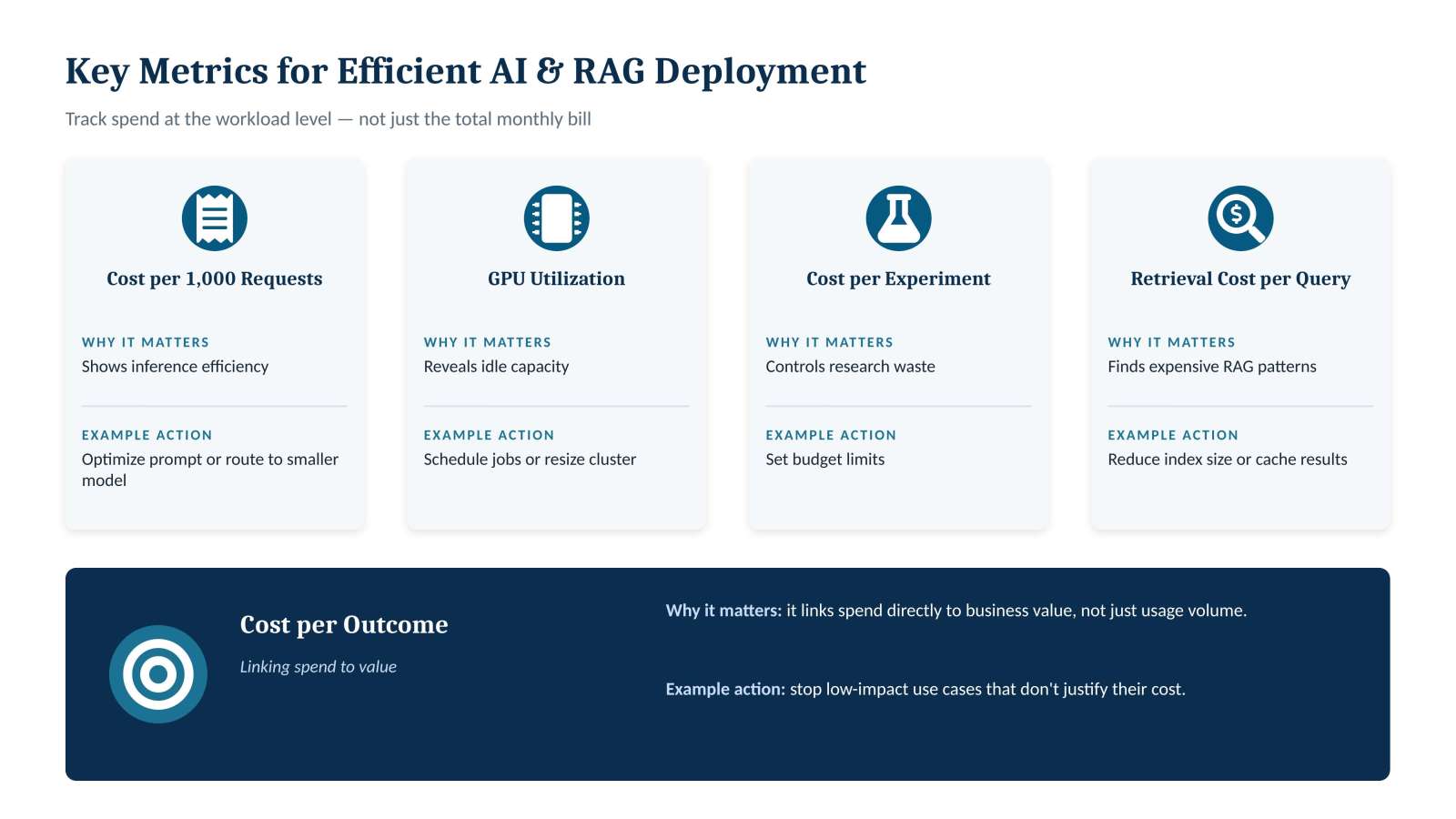
AI cost management starts with mapping every cost to a workload, owner, environment, and business outcome. Without this, teams may know the total cloud bill but not which model, feature, customer segment, or experiment created it.
Cost per model
Cost per inference request
Cost per training run
Cost per environment
Cost per product feature
Cost per customer or tenant
Cost per successful business action
This is where AI cost monitoring becomes essential. Dashboards should not only show “AI spend this month.” They should show which workloads are efficient, which are growing, and which no longer justify their cost.
Best AI Cost Optimization Strategies
The best AI cost optimization strategies reduce waste before cutting capability. Cost savings should come from better architecture, not from underpowering critical systems.
Start with these actions:
-
Right-size compute for each workload.
-
Use smaller models for simpler tasks.
-
Cache repeated responses or embeddings.
-
Schedule batch jobs outside peak periods.
-
Shut down idle development environments.
-
Monitor GPU utilization continuously.
-
Set budget alerts by team and workload.
-
Review model performance against cost.
AWS Cost Explorer rightsizing recommendations can identify opportunities to reduce spend by downsizing or terminating underutilized EC2 instances. AWS Compute Optimizer also supports recommendations across resources such as EC2, Auto Scaling groups, EBS volumes, ECS services, and databases.
For AI teams, this same logic applies beyond virtual machines. Oversized models, large context windows, over-indexed vector databases, and idle GPU nodes are all forms of overprovisioning.
Model Efficiency Is Part Of Cost Control
Model efficiency is one of the highest-impact AI cost optimization best practices. A larger model is not always better. Many production tasks can be handled by smaller models, routing rules, fine-tuned models, or task-specific pipelines.
Use model routing when different tasks have different complexity:
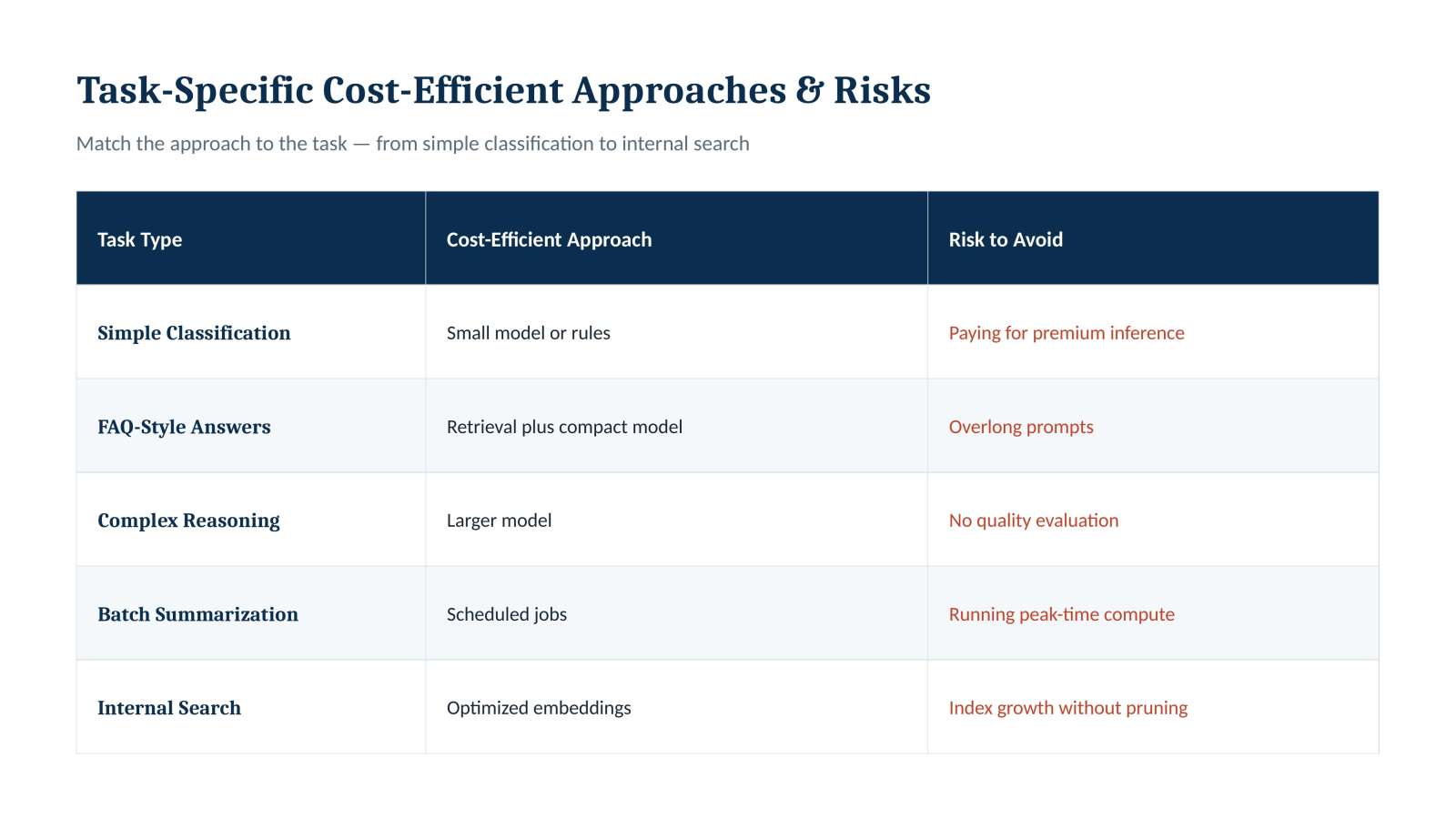
This is where an AI cost optimization tool can help, but tools do not replace architecture. The system still needs clear routing logic, quality thresholds, and fallback rules.
Some teams compare AI cost optimization tools, AI cloud cost optimization tools, and AI cloud cost optimization platforms at this stage. The useful question is not which platform has the most dashboards. It is whether the platform can connect cost data to engineering decisions.
AI For Cloud Cost Optimization
AI for cloud cost optimization means using machine learning or AI agents to detect waste, forecast spend, recommend rightsizing, identify anomalies, and suggest infrastructure changes. This can improve speed, but it should be governed carefully.
Common use cases include:
-
Detecting abnormal spend.
-
Forecasting future cloud usage.
-
Recommending rightsizing.
-
Finding idle resources.
-
Explaining cost spikes.
-
Prioritizing savings opportunities.
Microsoft’s Azure Well-Architected Framework treats cost optimization as a design discipline across organizational, architectural, and tactical levels. That is important because cloud cost optimization AI works best when architecture already includes tagging, ownership, budgets, and deployment controls.
An AI agent for cloud cost optimization can help FinOps teams summarize billing data, flag anomalies, and propose actions. But approval rules matter. Production changes should usually require human review, especially when they affect performance, availability, or compliance.
Where Cloud Infrastructure Changes Reduce AI Cost
AI cloud cost optimization often depends on infrastructure design. The same model can have very different costs depending on where it runs, how data moves, and how workloads scale.
For GAIA clients, cloud infrastructure planning is usually the right starting point. The architecture should define where AI workloads run, how they scale, which data stays regional, and how costs are monitored.
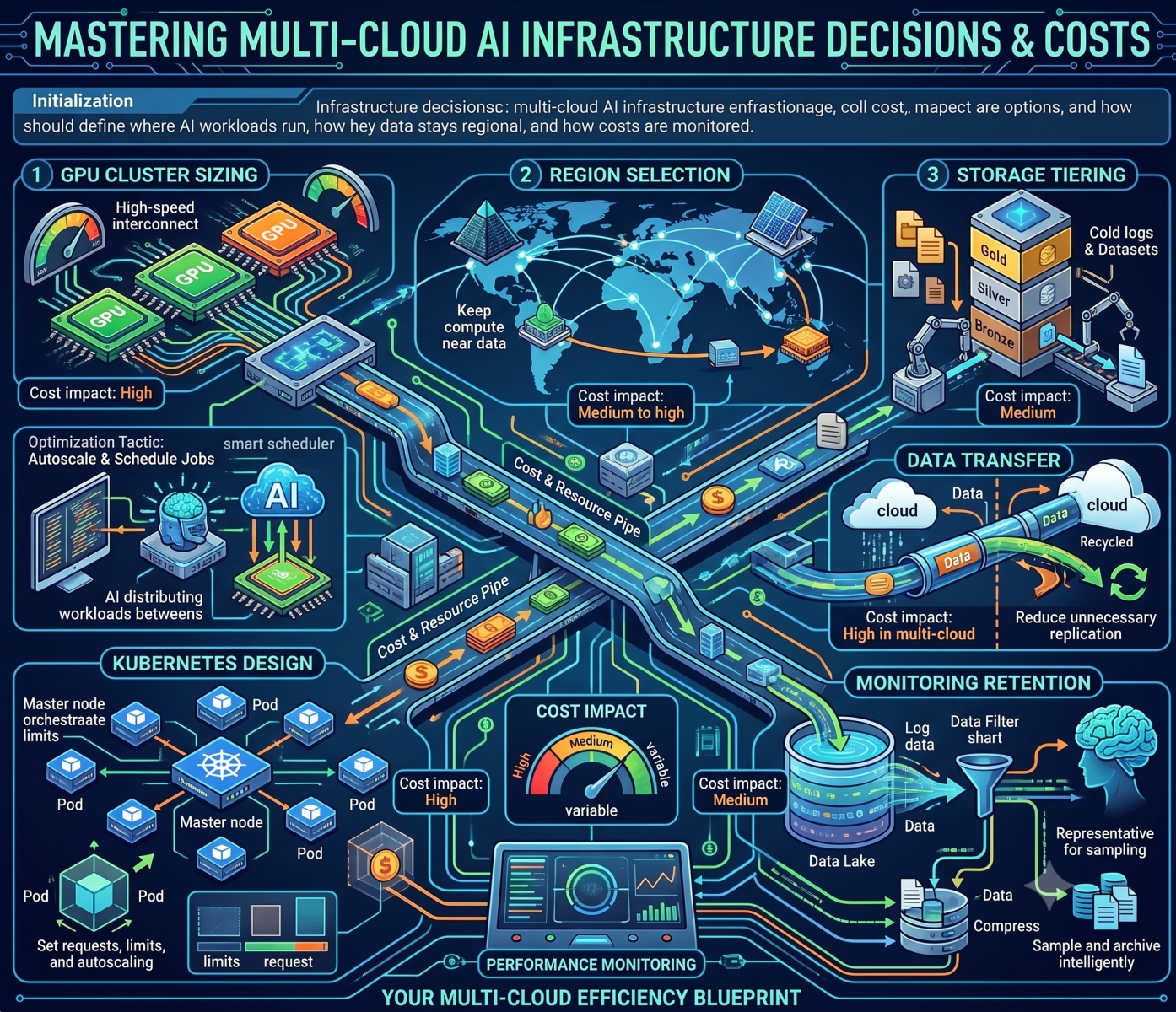
Kubernetes can also help when AI workloads need separate scaling and deployment control.
Tools and Platforms: What To Evaluate
AI cost optimization tools should be evaluated by the decisions they enable, not only by the charts they show. A dashboard that displays spend is useful. A system that explains waste and links it to owners is better.
When reviewing AI tools for cloud cost optimization, check whether they support:
-
Workload-level attribution.
-
Model-level cost tracking.
-
Budget alerts and anomaly detection.
-
GPU and CPU utilization reporting.
-
Kubernetes cost allocation.
-
Forecasting by environment.
-
Integration with CI/CD workflows.
Searches such as cast AI cost optimization usually point to Kubernetes automation and cluster savings. That category can be useful, but it only covers part of the problem. AI cost control also includes model routing, token usage, data pipelines, storage, and governance.
The strongest cloud cost optimization AI setup combines cloud billing data, observability, model metrics, infrastructure metadata, and business outcomes in one operating model.
Final thoughts
AI cost optimization is not a one-time cleanup. It is an operating discipline for keeping AI infrastructure efficient as usage grows. The best results come from visibility, ownership, rightsizing, model efficiency, infrastructure design, and continuous monitoring.
AI cloud cost optimization services should start with a simple map: which workloads exist, who owns them, what they cost, and what business value they create. From there, teams can apply the right AI cost optimization strategies without weakening performance.
GAIA can help businesses design AI infrastructure that is scalable, secure, and cost-aware from the start. If your team is adopting AI and cloud spend is becoming harder to predict, start with an architecture and cost review before adding another AI cost optimization tool.
FAQ
1. What is AI cost optimization?
AI cost optimization is the process of reducing the cost of AI workloads while keeping performance, security, and reliability stable. It covers model usage, cloud infrastructure, GPU compute, storage, data pipelines, monitoring, and governance.
2. Why are AI infrastructure costs so high?
AI infrastructure costs are high because AI workloads often require GPUs, large data pipelines, vector databases, model inference, API calls, and continuous monitoring. Costs can grow quickly when models are oversized, prompts are too long, environments stay idle, or teams do not track spend by workload.
3. How can companies reduce AI cloud costs?
Companies can reduce AI cloud costs by rightsizing compute, shutting down idle environments, using smaller models for simple tasks, caching repeated outputs, monitoring GPU utilization, optimizing data pipelines, and setting budget alerts for each team or workload.
4. What is the difference between AI cost optimization and cloud cost optimization?
Cloud cost optimization focuses on reducing general cloud waste, such as unused instances, oversized databases, and inefficient storage. AI cost optimization goes further by managing model inference, token usage, training jobs, GPU utilization, embeddings, vector search, and AI-specific monitoring costs.
5. What are the best AI cost optimization strategies?
The best AI cost optimization strategies include workload-level cost tracking, model routing, prompt optimization, GPU scheduling, autoscaling, storage tiering, budget governance, and continuous cost monitoring. The most effective approach is to reduce waste without cutting resources that directly affect product quality.
6. What should an AI cost optimization tool track?
An AI cost optimization tool should track cost per model, cost per request, GPU utilization, training job cost, inference cost, storage usage, vector database cost, data transfer, and spend by environment or team. The tool is most useful when it connects cloud spend to business outcomes.
Ready to implement AI for your business? Contact us now and let's start with a review.