What Cloud Infrastructure Works Best for Online Gaming Platforms?
The best cloud infrastructure for an online gaming platform is a hybrid or multi-cloud architecture with regional deployment, autoscaling, CDN acceleration, strong network security, and continuous cost monitoring. This setup helps platforms stay fast during traffic peaks, protect payment and user data, and avoid overpaying for idle capacity.
Online gaming platforms are not typical web applications. They handle unpredictable traffic, real-time user actions, payment flows, account systems, live content, and strict uptime expectations. A slow page is annoying. A slow session, delayed transaction, or failed login can immediately affect revenue and trust.
That is why infrastructure decisions should not start with “which provider is cheapest?” They should start with three questions:
-
Where are users located?
-
Which workloads must stay online at all times?
-
Which parts of the system need the lowest possible latency?
GAIA supports this type of planning through cloud infrastructure planning, CDN, cloud security, Kubernetes, cloud storage, co-location, database, AI, and big data services for enterprise environments. Its service model is relevant for businesses that need customized infrastructure rather than a one-size-fits-all hosting setup.
Why online gaming platforms need a different cloud setup
Online gaming platforms need cloud infrastructure that can absorb sharp traffic changes without slowing down core services. Traffic often rises in short windows: product launches, tournaments, promotions, seasonal campaigns, or peak evening hours.
A standard single-server or basic VPS setup usually fails for three reasons:
-
Compute capacity cannot scale fast enough.
-
Database load becomes a bottleneck.
-
Static and dynamic content travel too far from users.
Cloud architecture frameworks from AWS and Google Cloud both emphasize the same foundation: resilient, secure, high-performing, cost-effective infrastructure should be designed intentionally, not added later as a patch. AWS describes this through six pillars, including reliability, security, performance efficiency, and cost optimization. Google Cloud similarly frames architecture around secure, resilient, high-performing, and cost-effective topology design.
Core infrastructure options for online gaming platforms
The right infrastructure depends on platform size, geography, compliance needs, and internal engineering capacity. In practice, most mature platforms use a combination of cloud models.
.png)
For early-stage platforms, public cloud is often enough. For growing platforms with regional traffic, payment systems, and strict uptime needs, hybrid or multi-cloud infrastructure becomes more practical.
A strong setup usually separates workloads by function:
-
Frontend and static assets through CDN.
-
User-facing applications in scalable compute clusters.
-
Databases in managed or highly available environments.
-
Payment and identity services in tightly controlled network segments.
-
Analytics pipelines separated from transactional systems.
This separation makes the platform easier to scale and safer to operate.
Performance: latency matters more than raw server power
The best-performing cloud infrastructure is not simply the one with the largest server size. It is the one that places workloads close to users and removes avoidable bottlenecks.
For online gaming platforms, performance usually depends on four layers:
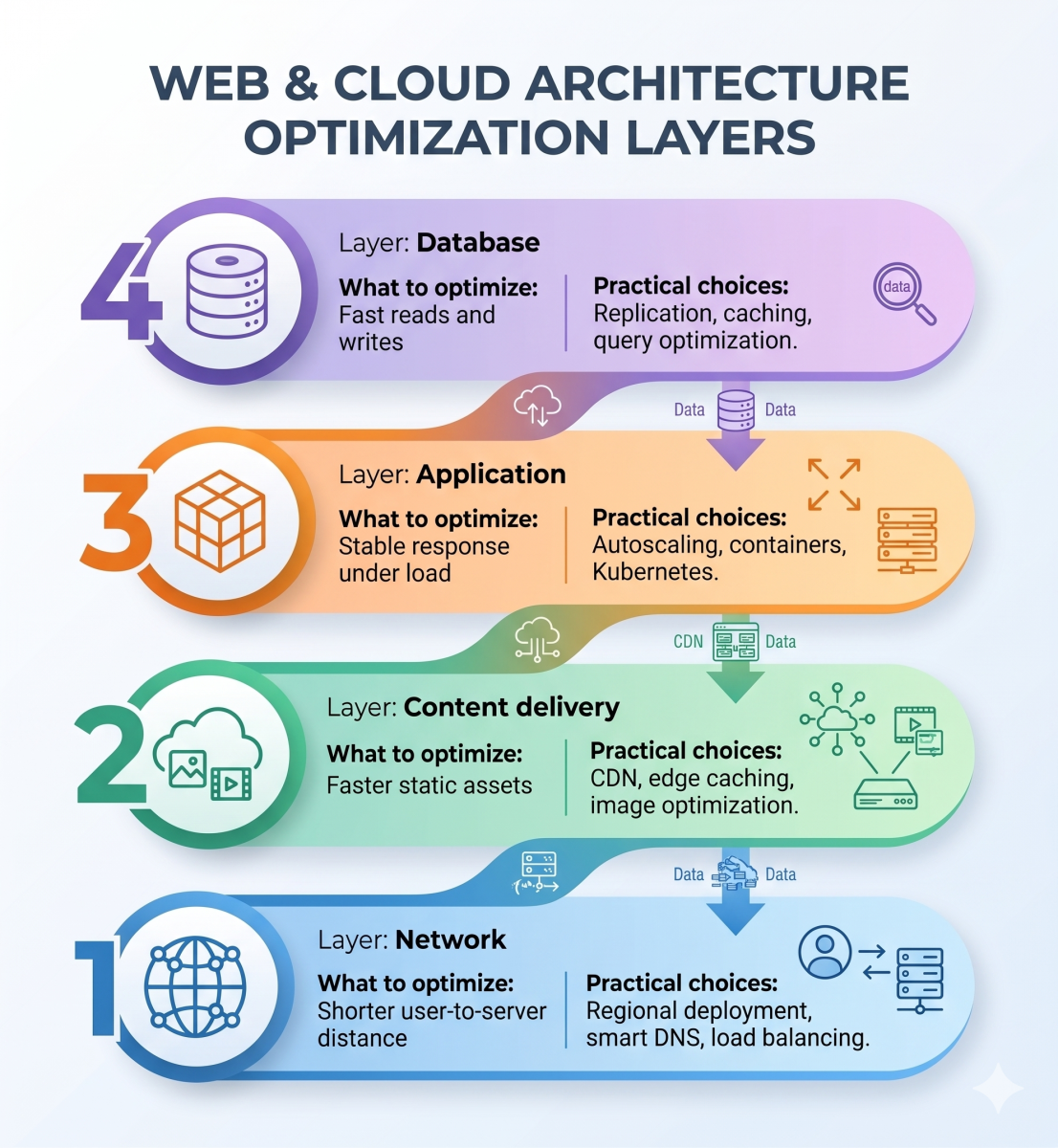
Autoscaling is especially important because traffic is rarely flat. Amazon EC2 Auto Scaling, for example, can launch or terminate instances as application demand changes and can balance capacity across Availability Zones to support availability.
For an online gaming platform, this means the system can expand during peak demand and reduce capacity later. The business pays for flexibility instead of permanently running peak-sized infrastructure.
Security: protect identity, payments, and platform availability
Security for online gaming platforms must cover three areas: user accounts, payment data, and service availability. A breach, account takeover, or large traffic attack can damage both revenue and brand trust.
The baseline security stack should include:
-
Web application firewall.
-
DDoS protection.
-
Identity and access management.
-
Secrets management.
-
Network segmentation.
-
Encryption in transit and at rest.
-
Security monitoring and incident response.
DDoS protection deserves special attention. Cloudflare reported that DDoS attacks more than doubled in 2025, while hyper-volumetric network-layer attacks grew sharply. This matters because traffic attacks are no longer rare edge cases; they are part of the operating risk for high-traffic digital platforms.
Payment security also needs architectural planning. PCI Security Standards Council states that PCI DSS defines technical and operational requirements for environments where payment account data is stored, processed, or transmitted.
For cloud teams, this means payment-related systems should be isolated from general application workloads. Access should be limited, logged, and reviewed regularly.
Kubernetes, containers, and DevOps maturity
Kubernetes is useful when a platform needs predictable deployment, service isolation, and faster scaling across environments. It is not required for every project, but it becomes valuable when teams manage many services.
GAIA positions Kubernetes as one of its core capabilities and states that it provides container migration, CI/CD infrastructure, and microservice architecture support.
Kubernetes works best when the team already has DevOps discipline. Without good monitoring, deployment rules, and cost controls, Kubernetes can become expensive and hard to manage.
Use Kubernetes when the platform needs:
-
Microservices instead of one large application.
-
Frequent releases.
-
Separate scaling for different services.
-
Consistent deployment across environments.
-
Better control over resource allocation.
Avoid it when the team only needs a simple application stack and has no internal capacity to manage container operations.
Cost control: cloud savings come from architecture, not discounts
The most cost-effective cloud infrastructure is not always the cheapest monthly plan. It is the setup where each workload uses the right resource type, scaling rule, and storage class.
Cost problems usually come from:
-
Overprovisioned compute.
-
Unused storage.
-
Poor database sizing.
-
No autoscaling limits.
-
No environment shutdown rules.
-
Expensive cross-region data transfer.
A practical FinOps model should track cost per environment, product feature, region, and workload. This gives management a clear view of which services drive cloud spend.
|
Cost Area
|
What to check | Optimization tactic |
| Compute | Idle instances and oversized machine | Autoscaling, rightsizing, reserved capacity |
| Storage | Old logs, backups, media files | Lifecycle policies and tired storage |
| Database | Expensive queries and unused replicas | Query tuning and replica review |
| Network | Cross-region traffic | Regional routing and CDN caching |
| Dev/Test | Always-on non-production environments | Scheduled shutdowns |
Cost control should not reduce reliability. The goal is to remove waste, not weaken the platform.
The best cloud architecture for online gaming platforms
The best architecture is usually a regional hybrid or multi-cloud setup with CDN, autoscaling compute, isolated payment systems, Kubernetes for service-heavy platforms, and active security monitoring. This model balances speed, uptime, compliance, and cost.
A practical target architecture may include:
-
CDN and edge routing for static content and faster delivery.
-
Load balancers distributing traffic across multiple zones.
-
Autoscaling application clusters for traffic peaks.
-
Managed databases with backups and replicas.
-
Separate secure network zones for payments and identity.
-
Centralized monitoring, logging, and cost dashboards.
This setup gives the business room to grow without rebuilding infrastructure every time traffic increases.
When to upgrade your current infrastructure
An online gaming platform should review its cloud setup when performance, reliability, or costs become unpredictable. The warning signs are usually visible before a major outage.
Consider an upgrade if:
-
Traffic peaks slow down core services.
-
Cloud bills grow faster than revenue.
-
Deployments cause frequent incidents.
-
Payment or login systems share too much infrastructure with general workloads.
-
Users in certain regions experience higher latency.
-
The team cannot explain which workloads drive cost.
These issues rarely disappear on their own. They usually become more expensive as the platform grows.
Final thoughts
The best cloud infrastructure for an online gaming platform is not a single product. It is an architecture built around traffic patterns, user geography, security needs, and business risk.
Public cloud gives speed. Hybrid cloud gives control. Multi-cloud gives flexibility. CDN improves delivery. Autoscaling protects performance. Security and compliance keep the platform trustworthy.
GAIA can help design, migrate, and manage cloud infrastructure for platforms that need scalable, secure, and cost-efficient environments. If your current setup is slowing growth or becoming hard to control, the next step is a structured cloud architecture review.