Agentic AI architecture is the system design that allows AI agents to understand goals, plan tasks, use tools, take actions, and adjust based on results. It connects a reasoning model with memory, APIs, data sources, orchestration, monitoring, and security controls.
This is different from a basic chatbot architecture. A chatbot usually responds to user input. An agentic AI system can break a goal into steps, retrieve information, call tools, update records, trigger workflows, and ask for approval when needed.
For businesses, the main challenge is not only choosing a model. The harder task is building a safe, observable, and scalable agent architecture around it. GAIA supports this through AI solutions for automation, analytics, security, real-time data processing, and high-load infrastructure planning.
What is agentic AI architecture?
Agentic AI architecture is a technical framework that combines reasoning, memory, tool use, action, and feedback loops so AI agents can complete multi-step workflows. It defines how an agent understands context, chooses actions, interacts with systems, and reports outcomes.
At a high level, the architecture includes:
-
A model for reasoning.
-
Memory for context.
-
Tools for external actions.
-
Orchestration for workflow control.
-
Monitoring for visibility.
-
Guardrails for safety.
Google Cloud describes AI agents as systems that use AI to pursue goals and complete tasks on behalf of users, with reasoning, planning, memory, autonomy, learning, and adaptation. This makes architecture critical because the agent must operate across multiple systems, not only generate text.
Core components of AI agent architecture
AI agent architecture works best when each component has a clear role. Without separation, agents become hard to debug, expensive to run, and risky to deploy.
| AI type |
Role in the architecture
|
Practical example |
| Perception layer | Collects and interprets input | Reads a ticket, alert, document, or user request |
| Reasoning layer | Decides what the goal requires | Breaks a task into steps |
| Memory layer | Keeps context across the workflow | Stores previous actions and relevant history |
| Tool layer | Connects the agent to systems | Calls APIs, databases, SaaS tools, or workflows |
| Action layer | Executes approved steps | Updates a record or triggers a process |
| Feedback layer | Checks results and adjusts | Retries, escalates, or changes the plan |
| Governance layer | Controls permissions and risk | Logs actions and applies approval rules |
This structure is the difference between a useful agent and an unpredictable automation script. A good architecture of AI makes every step visible, testable, and controllable.
How do AI agents work?
AI agents plan and act by moving through a loop: understand the goal, inspect context, choose a next step, use a tool, observe the result, and decide whether to continue. This loop may happen once or many times during one workflow.
A typical agent loop looks like this:
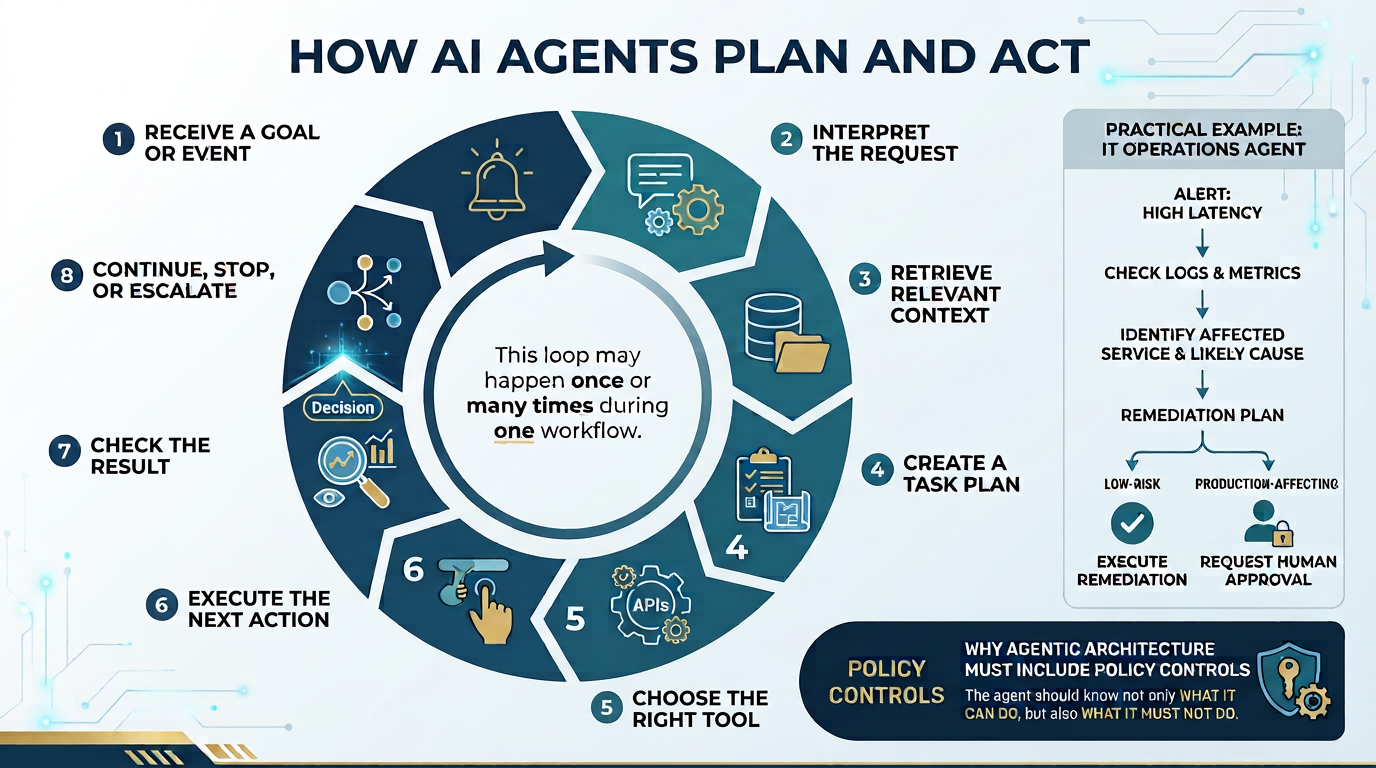
For example, an IT operations agent may receive an alert about high latency. It checks logs, compares current metrics with normal patterns, identifies the affected service, suggests a likely cause, and creates a remediation plan. If the action is low-risk, it may execute it. If the action affects production, it should request human approval.
This is why agentic architecture must include policy controls. The agent should know not only what it can do, but also what it must not do.
Tool use in LLM agent architecture
LLM agent architecture depends on tool use because language models cannot directly operate business systems on their own. Tools are the controlled interfaces that let an agent retrieve data, call APIs, run searches, create tickets, update systems, or trigger workflows.
Tool design should answer four questions:
What tools can the agent access?
What data can each tool expose?
Which actions are read-only?
Which actions require approval?
| Tool type | What it enables | Risk to manage |
| Search tools | Retrieve documents or knowledge | Outdated or irrelevant context |
| Database tools | Query structured data | Excessive access to sensitive records |
| API tools | Update or trigger systems |
Unauthorized changes |
| Code tools | Generate or test scripts | Unsafe execution |
|
Workflow tools
|
Create tickets or tasks |
Duplicate or incorrect actions |
Tool permissions should be narrower than human permissions. An agent that only needs to read incident logs should not be able to delete records, modify access settings, or deploy code.
Single-agent, multi-agent, and agent based architecture
Agent based architecture can be designed in several ways. The right model depends on task complexity, risk, latency, and how much coordination the workflow needs.
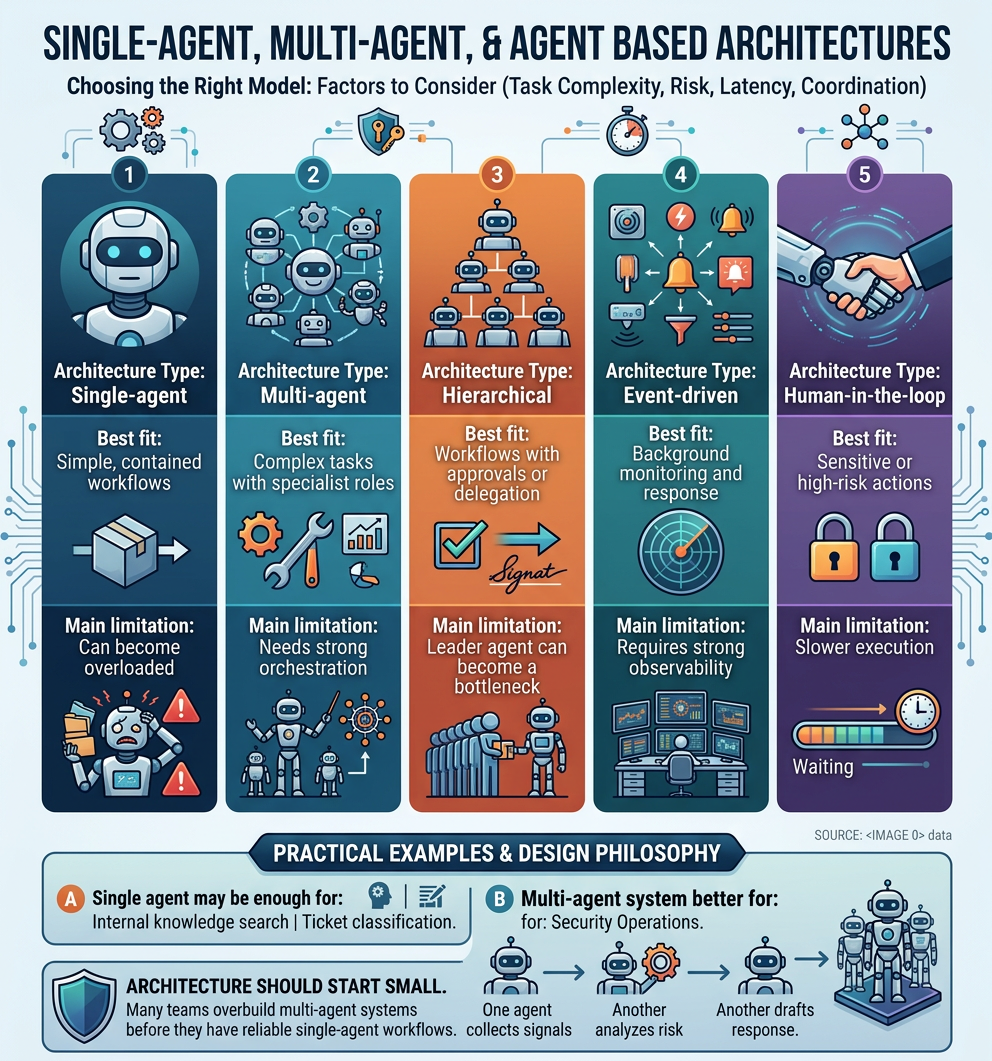
A single agent may be enough for internal knowledge search or ticket classification. A multi-agent system may be better for security operations, where one agent collects signals, another analyzes risk, and another drafts response actions.
The architecture should start small. Many teams overbuild multi-agent systems before they have reliable single-agent workflows.
Infrastructure behind agentic AI systems
Agentic AI systems need infrastructure because they connect models to real operations. A prototype can run in a notebook. A production agent needs scalable compute, secure integrations, state management, observability, and cost control.
The infrastructure layer usually includes:
- API gateway
- Identity and access management
- Model serving environment
- Vector database or memory store
- Event queue
- Logging and monitoring
- Secure secrets management
- CI/CD pipeline.
For companies deploying agents at scale, cloud infrastructure planning becomes part of the AI project. Agents may need autoscaling, regional deployment, low-latency APIs, and separate environments for testing and production.
Kubernetes can also be useful when several agents or services need independent scaling. However, Kubernetes should not be added by default. It is valuable when the system has clear service boundaries, deployment needs, and operational maturity.
Security and governance for agent architecture in AI
Security is central to agent architecture in AI because agents can act. A weakly governed agent may expose data, misuse tools, follow malicious instructions, or make incorrect changes at scale.
The safest architecture uses bounded autonomy. The agent can complete low-risk actions, but sensitive actions require review.
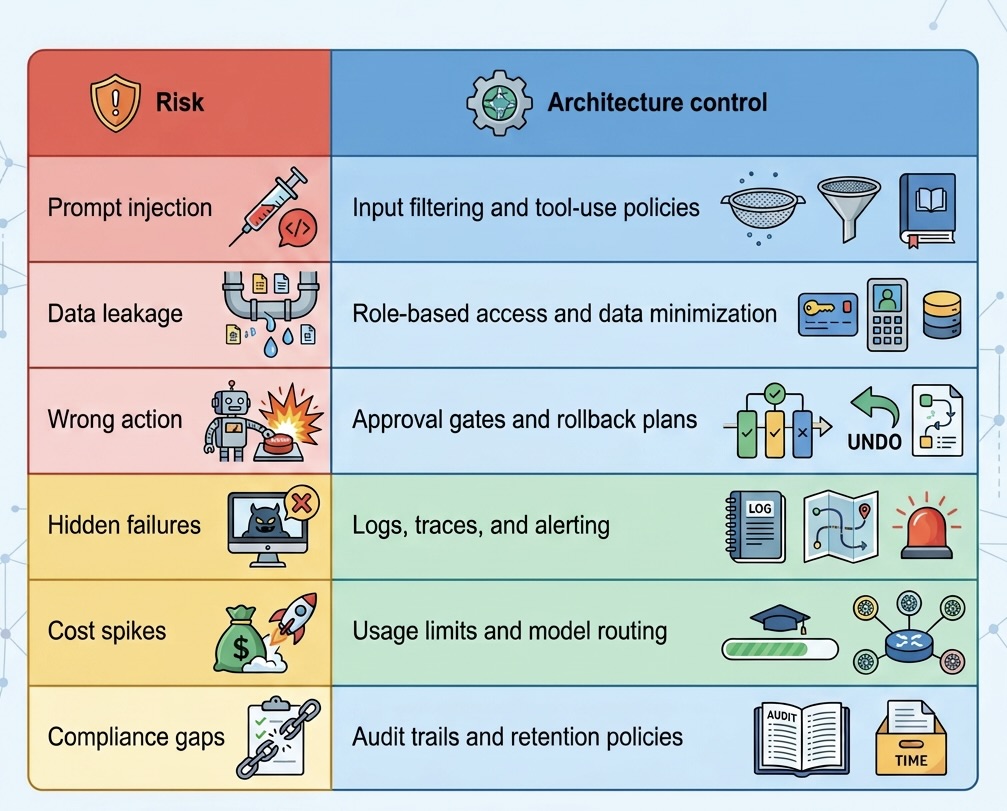
NIST’s AI Risk Management Framework is useful here because it frames AI risk around governance, mapping, measurement, and management. For agentic systems, those ideas should become concrete controls: who owns the agent, what it can access, how it is monitored, and when humans intervene.
GAIA’s Cyber Security services are relevant where AI agents interact with sensitive systems, APIs, infrastructure, or customer data.
Best practices for building agentic architecture
The best agentic AI architecture is narrow, observable, and governed from the start. The goal is not to give the agent maximum autonomy. The goal is to give it enough autonomy to create value safely.
Start with these practices:
- Choose one workflow with clear inputs and outputs.
- Define what the agent can and cannot do.
- Start with read-only tools before write actions.
- Log every tool call and decision.
- Add human approval for high-risk steps.
- Monitor latency, cost, errors, and outcomes.
- Test with real edge cases.
- Expand only after performance is stable.
A practical rule: if a human cannot clearly describe the workflow, an agent should not automate it yet. Document the process first, then design the agent.
Common mistakes in agentic architecture
Most agentic AI failures come from weak architecture, not weak models. A strong model cannot fix unclear permissions, poor data quality, or missing monitoring.
Common mistakes include:
- Giving agents too many tools too early
- Skipping access control design
- Using long prompts instead of structured workflows
- Not separating test and production environments
- Ignoring cost per task
- Failing to log intermediate steps
- Treating human review as optional
Another mistake is assuming that more agents always means better results. Multi-agent systems can improve specialization, but they also add coordination overhead. Use them when the workflow genuinely needs separate roles.
Final thoughts
Agentic AI architecture turns AI from a response generator into an operational workflow layer. The agent can plan, use tools, act, observe results, and continue toward a goal. But that only works when the surrounding architecture is secure, observable, and well governed.
The strongest systems combine reasoning, memory, tool access, orchestration, cloud infrastructure, monitoring, and human approval. This makes agents useful in real business workflows without giving them uncontrolled authority.
GAIA can help businesses design the infrastructure layer behind agentic AI systems, from cloud architecture and API integration to security and scalable deployment. Before building a complex agent system, start with the architecture: tools, permissions, data, monitoring, and risk controls.

NEW eBook Alert!
The Agentic AI Era: Reshaping the Future of Games
Discover how AI agents are transforming game development, user acquisition, and operations.