A game CDN moves builds, patches, asset bundles, and web endpoints to edge nodes near players and keeps the origin off the delivery path. It fixes what publishers and developers actually hear complaints about: slow first install, slow patch day, and unstable access at peak. What it does not fix is in-match latency, which travels between the client and the game server. This page separates the two and shows what to change.
What is a gaming CDN?
A gaming CDN is a delivery network tuned for game-shaped traffic: multi-gigabyte builds, frequent patches, launcher and store endpoints, and release-timed spikes that arrive as a coordinated wave rather than a daily curve. It caches large objects at edge points of presence and terminates player connections locally.
A general-purpose web CDN configuration underperforms here for one reason: the shape is different. Object sizes are orders of magnitude larger, cache value hinges on a few very hot objects on release day, and part of the traffic is the opposite case entirely: small, high-frequency real-time packets that caching does not serve.
Table 1. Web workload vs. game workload
| Parameter | Typical web workload | Game workload |
| Object size | KB to a few MB | Migration roadmap and architecture decisions |
|
Traffic shape
|
Diurnal curve, gradual peaks | Timeline, milestones, resources |
| Cache value | Broad long tail |
Concentrated in a few hot objects
|
| Failure mode | Higher error rate under load | Download aborts, patch stalls, login timeouts |
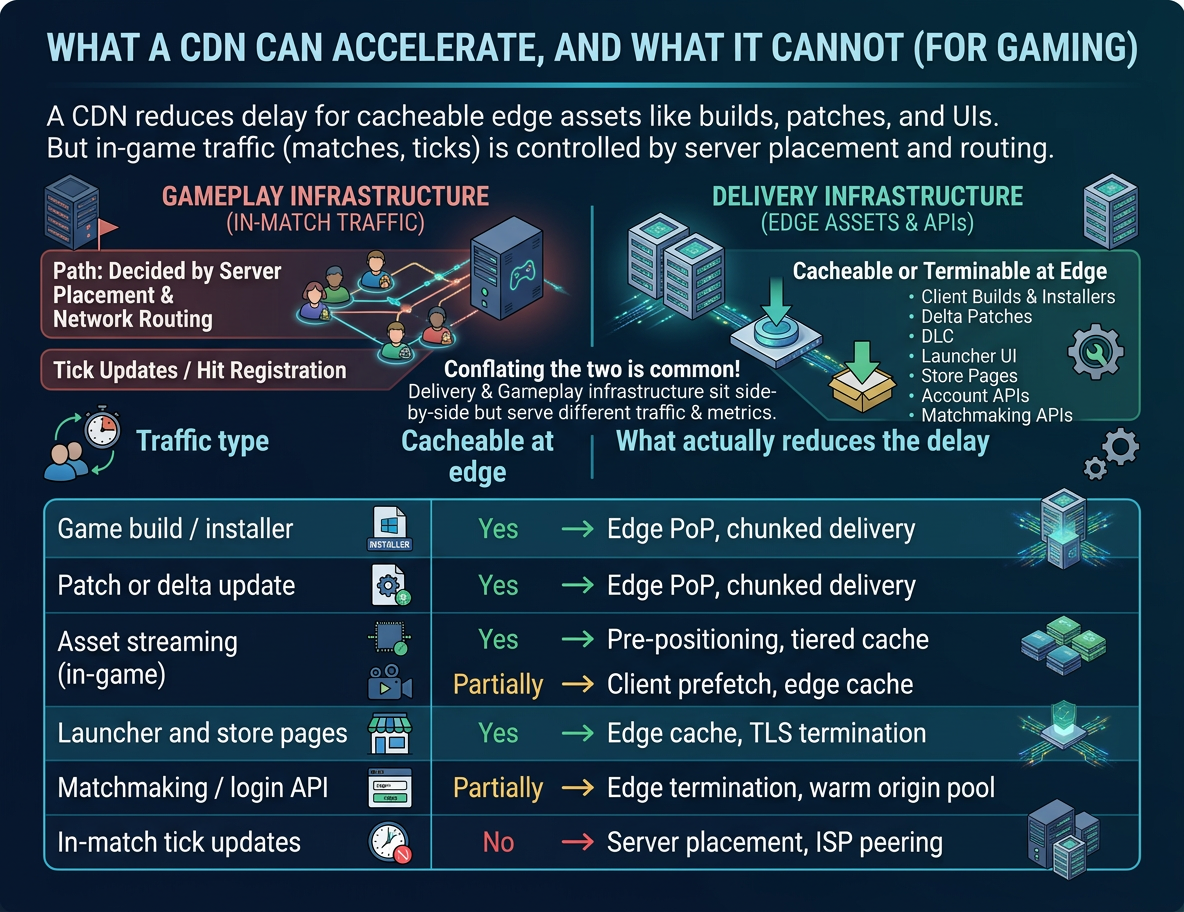
What a CDN can accelerate, and what it cannot
Cacheable or terminable at the edge: client builds and installers, delta patches, DLC, asset bundles, launcher UI, store pages, and account and matchmaking APIs. Everything that happens during a match, from tick updates to hit registration, travels between the client and the game server. That path is decided by server placement and network routing, not by any CDN.
Conflating the two is common in cdn gaming discussions. Delivery infrastructure and gameplay infrastructure sit side by side but move different traffic and answer to different metrics.
Table 2. What edge delivery changes, and what it does not
How does a gaming CDN reduce latency?
A cdn for gaming shortens the physical and logical path between the player and the data. A nearby PoP answers the request, the TLS handshake terminates locally, connections back to origin stay warm, and origin fetches are kept off the critical path during release spikes.
Four levers do most of the work:
-
Edge PoP proximity to the player's ISP
-
TLS and HTTP/3 termination at the edge
-
Tiered cache or origin shield in front of the origin
-
Pre-positioning of release content before it goes live
Latency, jitter, and packet loss are separate problems
Latency is the round-trip time. Jitter is the variance in that time. Packet loss is the share of packets that never arrive. Gamers call all three "lag."
Different genres tolerate different budgets. Competitive shooters degrade above 30 to 50 ms, MOBAs and battle royales stay playable to around 80 ms, turn-based titles absorb far more. Riot Games engineers have documented that peering with ISPs raised the share of League of Legends players connected under 80 ms ping from 31% to 50% in about nine months. That result came from peering, not caching. A CDN removes the delivery load that degrades those paths at peak; peering and server placement are what shorten them.
Where cloud gaming changes the picture
In streamed play, every input and every rendered frame crosses the network, so the tolerance collapses. Edge proximity begins to affect gameplay itself, not only delivery. Industry analysis from ABI Research puts the practical target at 20 to 70 ms with an 80 ms ceiling for a usable experience. That pushes cloud computing planning toward more locations, smaller deployments, and closer proximity to last-mile networks.
How to speed up game downloads and patch distribution
Three decisions determine patch-day outcomes: package smaller updates, place content at the edge before players request it, and keep the origin serving one copy per region. Scale is the reason. Valve reported that Steam alone delivered about 100 exabytes of installs and updates in 2025, roughly 274 petabytes per day platform-wide. That is total platform delivery, and every publisher on it competes for the same last-mile capacity on the same evenings.
Six steps that a cdn for online gaming makes practical:
-
Deliver as delta or chunked updates, not full-package replacements.
-
Use stable chunk hashes so unchanged data stays cached.
-
Open a preload window before the release timestamp.
-
Warm regional caches ahead of the announced launch.
-
Configure tiered caching so edges pull from a shield, not origin.
-
Stagger regional release times to flatten the global spike across multiple markets.
How a CDN protects origin infrastructure
The edge absorbs traffic the origin should never see: repeated downloads, scrapers, and the volumetric share of attack traffic. Offload is measured as bytes served from cache. Gaming stays one of the most attacked verticals: Akamai data puts it at 18% of Layer 3 and 4 DDoS attacks, behind financial services at 34% and ahead of high technology at 15%.
Where an online gaming cdn helps at the delivery layer:
-
Origin shield to isolate cache fills from user traffic
-
Rate limits on account and login endpoints
-
Bot filtering on store and launcher paths
-
Cache-fill isolation on origin servers during patch cycles
-
Autonomous mitigation of volumetric floods
Behavioural application-layer detection sits on a separate cybersecurity layer; firewalls and CDNs alone are not enough for a live player-facing platform.
How to choose the best CDN for gaming
The decision runs on four axes: regional coverage against the actual player map, large-object and range-request handling, the egress cost model, and how much control the buyer has over cache and purge behaviour. Node counts are a poor proxy. In Asia-Pacific and cross-border delivery, evening-peak behaviour on specific carrier links matters more than the size of a coverage map.
Table 3. Evaluation criteria for the best cdn for gaming
| Criterion | Why it matters for games | Red flag |
| PoP coverage in real player regions | Proximity to ISPs, not a global map | Coverage claims without per-country data |
|
Large-object and range-request handling
|
Patch delivery depends on it | Optimised only for web-scale objects |
| Purge speed | Bad patches need to be pulled fast |
Purge measured in minutes, not seconds
|
| Tiered cache / origin shield | Impact on origin during release spikes | Direct edge-to-origin fill only |
| DDoS mitigation scope | Volumetric floods hit the delivery layer first | L3/L4 only, no application coverage |
| Egress pricing model | Attack traffic can appear on the invoice | Scrubbed traffic billed as normal egress |
| Cross-border and Greater China delivery | ICP filing and carrier links define the result | No stated ICP support |
| Real-time logs and per-region metrics | Ensure regressions do not hide in global averages | Aggregated logs only |
How to validate a provider before you commit
Latency is the round-trip time. Jitter is the variance in that time. Packet loss is the share of packets that never arrive. Gamers call all three "lag."
Different genres tolerate different budgets. Competitive shooters degrade above 30 to 50 ms, MOBAs and battle royales stay playable to around 80 ms, turn-based titles absorb far more. Riot Games engineers have documented that peering with ISPs raised the share of League of Legends players connected under 80 ms ping from 31% to 50% in about nine months. That result came from peering, not caching. A CDN removes the delivery load that degrades those paths at peak; peering and server placement are what shorten them.
Metrics that show the delivery layer is working
A handful of numbers describe delivery health, and every one of them must be read per region. A healthy global average routinely hides a failing market.
-
Cache hit ratio, or share of bytes served from cache
-
Origin egress per patch cycle
-
Download completion and abort rate
-
p95 and p99 throughput by country
-
Time to first byte at the edge
-
Mitigated attack events by type
Cadence matters as much as the numbers. Baseline before the next patch, then compare the same window after any change.
Final Thoughts
For most teams the first move is not a provider switch. It is a two-step audit: map players by region, then compare that map against current PoP coverage and origin location. The second move is measuring offload and per-region completion rate on the next patch cycle, then repeating the same measurement after any change.
For a second pair of eyes on your delivery map or origin protection posture, talk to GAIA.

NEW eBook Alert!
The Agentic AI Era: Reshaping the Future of Games
Discover how AI agents are transforming game development, user acquisition, and operations.