AI is transforming cloud security by helping organizations detect threats faster, prioritize risks more accurately, and automate repetitive security tasks. Rather than replacing security teams, AI enhances their ability to analyze massive volumes of cloud telemetry, identify suspicious behavior, and respond to incidents before they become business-critical.
Cloud environments generate billions of security events every day across virtual machines, containers, APIs, identities, SaaS applications, and networks. Manual analysis alone is no longer practical. This is why AI in cloud security has become a core capability of modern security platforms, supporting security analysts with real-time detection, investigation, and response.
Organizations adopting cloud computing and AI together should view artificial intelligence as part of a broader security architecture rather than a standalone tool. Effective implementations combine AI models with cloud-native infrastructure, access controls, continuous monitoring, and human oversight.
Businesses building AI-powered cloud environments should also consider the underlying infrastructure. GAIA provides enterprise-grade AI solutions alongside cloud infrastructure, cybersecurity, Kubernetes, and data engineering services that support secure AI deployment at scale.
What Is AI in Cloud Security?
AI in cloud security refers to the use of artificial intelligence and machine learning to improve threat detection, automate security operations, analyze risks, and strengthen cloud infrastructure. Instead of relying solely on predefined rules, AI continuously evaluates patterns across users, workloads, networks, and cloud services to identify suspicious activity.
Unlike traditional security tools, AI can correlate millions of events that would be impossible for analysts to review manually.
The combination of cloud computing and artificial intelligence enables organizations to:
-
detect anomalies in real time;
-
prioritize alerts based on actual risk;
-
automate repetitive investigations;
-
reduce response times;
-
improve visibility across complex cloud environments.
According to Google’s Security Best Practices, organizations should combine AI with strong identity management, least-privilege access, continuous monitoring, and layered security controls rather than treating AI as a replacement for security architecture.
How AI Improves Cloud Security
The biggest advantage of AI cloud security is its ability to process enormous volumes of security data far faster than humans while continuously learning from new patterns.
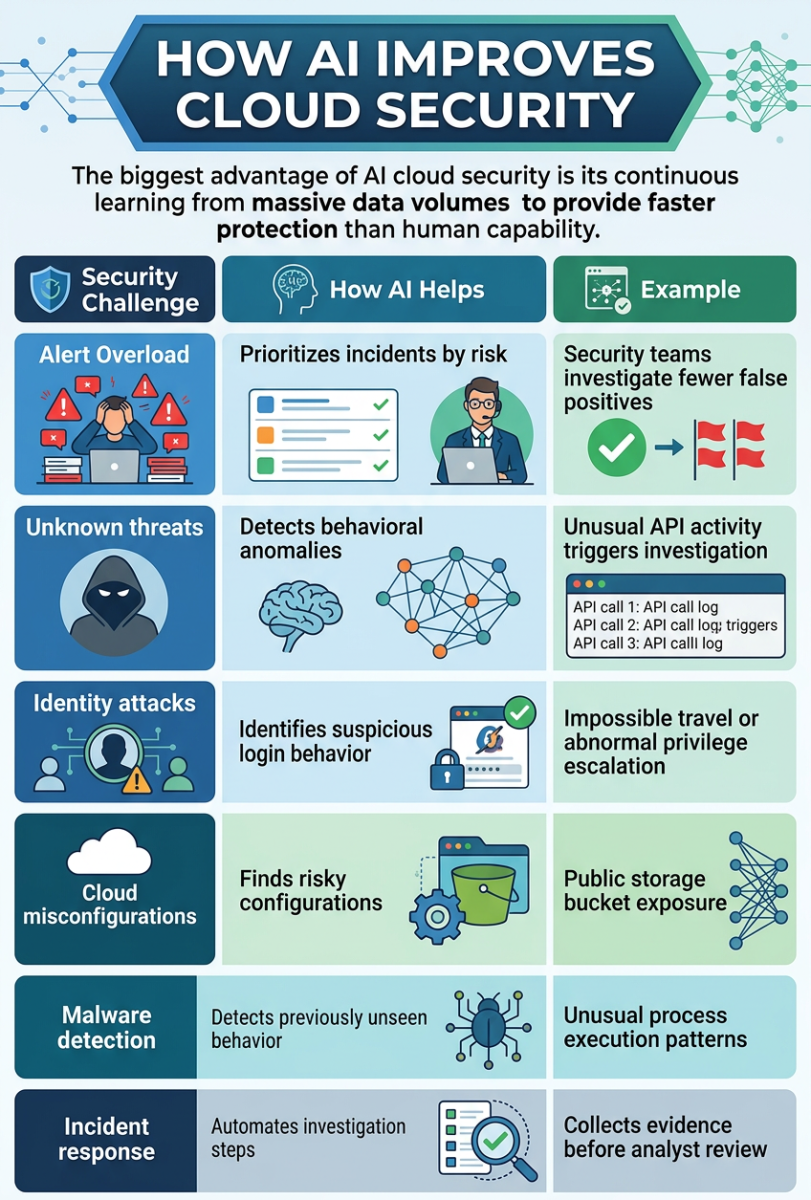
Rather than replacing analysts, AI allows security teams to focus on incidents that genuinely require human expertise.
This is particularly valuable because cloud environments change constantly. New workloads, APIs, Kubernetes clusters, and user identities are created every day, making static rule-based detection increasingly difficult.
AI for Network Security in Cloud Environments
AI for network security helps organizations detect abnormal communication patterns that traditional signature-based tools may miss.
Instead of looking only for known attack signatures, AI evaluates how systems normally communicate and flags behavior that deviates from established baselines.
For example, AI can identify:
-
unexpected east-west traffic between workloads;
-
unusual API requests;
-
lateral movement inside cloud environments;
-
compromised service accounts;
-
command-and-control communication;
-
abnormal DNS requests.
Modern cloud environments are highly dynamic. Traditional perimeter-based monitoring often struggles because workloads move across regions, containers are short-lived, and APIs continuously change.
AI complements Zero Trust architectures by continuously evaluating whether network behavior matches expected patterns instead of assuming previously trusted traffic remains safe.
Common AI Use Cases in Cloud Security
Organizations are already applying AI across nearly every stage of cloud security operations.
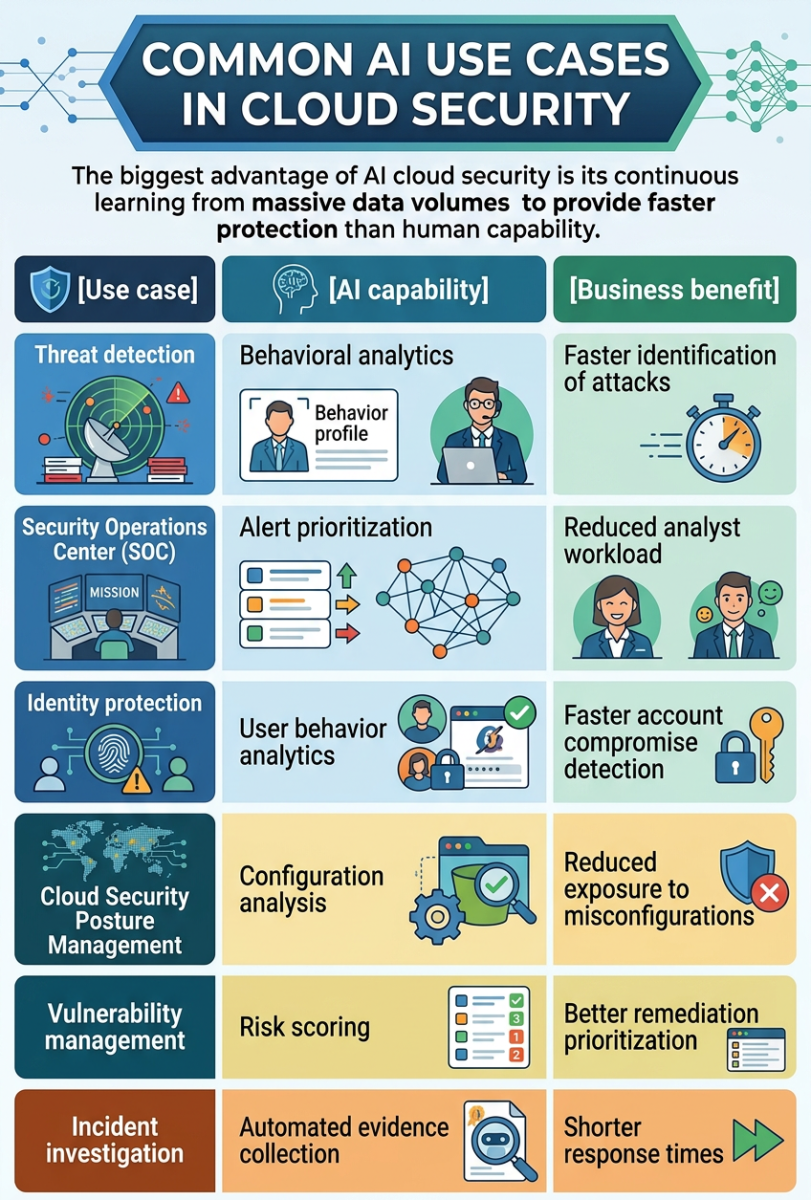
Many of these capabilities are evolving further through agentic AI, where AI systems perform multi-step investigations, collect evidence, and recommend remediation before involving human analysts. We explored this approach in more detail in our guide to agentic AI and how autonomous AI systems support operational workflows.
Benefits of AI Cloud Security
AI significantly improves cloud security by helping organizations respond faster, reduce operational workload, and make better security decisions. However, the biggest benefit is not full automation—it’s giving security teams the context they need to act quickly and confidently.
According to the IBM Cost of a Data Breach Report, organizations that extensively use AI and automation identify and contain breaches significantly faster than those that do not, leading to substantially lower breach costs.
The most valuable benefits include:
| Benefit | Why it matters | Business impact |
| Faster threat detection | AI analyzes millions of events in real time | Earlier attack containment |
| Reduced alert fatigue | Low-priority alerts are filtered automatically | Analysts spend time on critical incidents |
| Better threat prioritization |
|
Faster incident response |
| Continuous monitoring | Security operates 24/7 | Reduced detection gaps |
| Automated investigations | AI gathers logs and evidence before analysts begin | Shorter investigation time |
| Adaptive protection | Models learn from new behaviors | Better detection of emerging threats |
Another advantage is scalability. As organizations adopt more cloud services, containers, APIs, and SaaS applications, manually reviewing every event becomes impossible. AI allows security teams to scale operations without increasing headcount at the same pace.
Companies investing in AI infrastructure should also pay attention to operational efficiency. As AI workloads grow, cloud spending can increase rapidly if compute resources are not monitored carefully. Our guide to AI cost optimization explains practical strategies for reducing infrastructure costs while maintaining performance.
Risks of Using AI in Cloud Security
AI improves security, but it also introduces new risks. Organizations should treat AI as another critical system that requires governance, monitoring, and continuous validation.
The most common risks include:
| Risk | Potential impact | Mitigation |
| False positives | Wasted analyst time | Human validation and model tuning |
| False negatives | Missed threats | Layer AI with traditional detection methods |
| Prompt injection |
Manipulated AI responses
|
Input validation and tool restrictions
|
| Model drift | Reduced detection accuracy over time | Continuous monitoring and retraining |
| Data poisoning |
Corrupted training data |
Data validation and secure pipelines |
| Excessive permissions | Unauthorized actions | Least-privilege access and approval workflows |
The NIST AI Risk Management Framework recommends governing AI systems throughout their lifecycle by mapping risks, measuring performance, implementing controls, and continuously monitoring deployed models. These principles are particularly important when AI systems have access to production cloud infrastructure or sensitive security data.
One common misconception is that AI should automatically respond to every detected threat. In practice, organizations achieve better outcomes when AI performs low-risk actions—such as collecting evidence, enriching alerts, or suggesting remediation—while humans approve changes that affect production systems.
Best Practices for Implementing AI Cloud Security
Successful AI adoption begins with a well-designed cloud security strategy rather than selecting the newest AI model. Organizations that see the greatest value typically start with a narrow use case, measure results, and expand gradually.
Consider these AI cloud security best practices:
-
Build on a strong cloud security foundation. AI cannot compensate for weak identity management, poor network segmentation, or insecure APIs.
-
Keep humans involved in critical decisions. High-impact actions, such as changing firewall policies or disabling accounts, should require approval.
-
Monitor AI performance continuously. Detection models should be evaluated regularly for accuracy, false positives, and concept drift.
-
Protect AI infrastructure. Secure model endpoints, APIs, training pipelines, and vector databases using the same security controls as other production systems.
-
Apply least-privilege access. AI services should access only the data and systems required for their tasks.
-
Maintain complete audit trails. Every recommendation, tool invocation, and automated action should be logged for investigation and compliance.
-
Measure business outcomes, not just technical metrics. Track improvements in mean time to detect (MTTD), mean time to respond (MTTR), alert volume, and analyst productivity.
These practices align with recommendations from major cloud providers, including Google Cloud and Microsoft, which emphasize combining AI with Zero Trust principles, continuous monitoring, and layered security controls rather than relying on AI alone.
AI, Cloud Infrastructure, and Industry-Specific Security
Different industries face different security challenges, but the underlying infrastructure principles remain consistent. Whether supporting financial services, healthcare, manufacturing, or an online gaming platform, AI strengthens cloud security by improving visibility across distributed environments.
For example, platforms processing large volumes of user activity benefit from AI-driven anomaly detection that identifies unusual login patterns, API abuse, or abnormal network behavior before they escalate into security incidents.
We explored how cloud infrastructure supports these environments in our article on AI in online gaming infrastructure, where AI is used to improve performance, automate operations, and strengthen platform resilience.
As organizations expand AI adoption, security should evolve alongside infrastructure—not as an afterthought.
How GAIA Supports Secure AI-Powered Cloud Infrastructure
Deploying AI securely requires more than selecting a model. Organizations need scalable cloud infrastructure, secure APIs, observability, identity management, and governance that can support AI workloads in production.
GAIA helps businesses build these capabilities through cloud computing, cybersecurity, AI integration, Kubernetes, data engineering, and infrastructure consulting. Rather than treating AI as a standalone product, GAIA focuses on integrating AI into secure, scalable cloud environments designed for enterprise workloads.
Final thoughts
AI is becoming a core component of modern cloud security because it enables organizations to analyze massive volumes of data, detect threats faster, and automate repetitive security operations. However, successful implementation depends on much more than deploying an AI model.
The most effective AI cloud security strategies combine artificial intelligence with secure cloud architecture, identity management, continuous monitoring, governance, and human oversight. AI should enhance security professionals—not replace them.
As cloud environments continue to grow in scale and complexity, organizations that invest in both AI capabilities and resilient cloud infrastructure will be better positioned to detect threats, reduce operational burden, and respond confidently to emerging cyber risks.

NEW eBook Alert!
The Agentic AI Era: Reshaping the Future of Games
Discover how AI agents are transforming game development, user acquisition, and operations.